
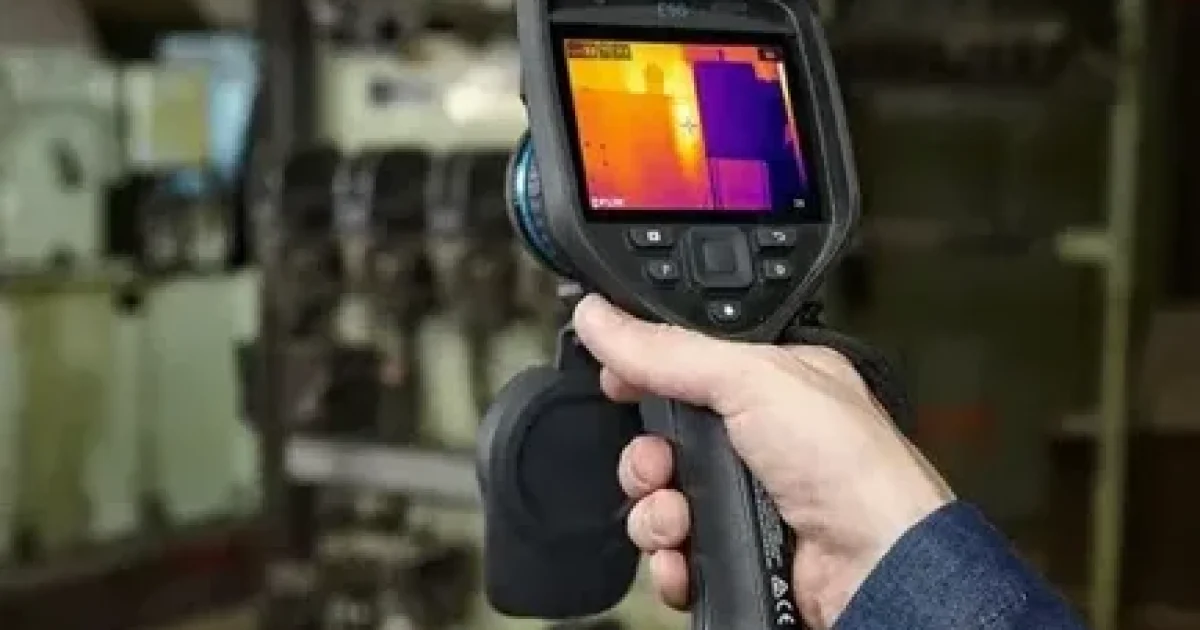
Some equipment problems are easy to see. A damaged cable, leaking pipe, or visibly worn component can often be identified during a routine inspection. Other problems, however, can develop quietly inside electrical systems, machinery, and buildings long before there is an obvious sign of failure.
This is where an infrared thermography camera can be useful.
Thermal imaging allows temperature differences to be visualized without physically touching the surface being inspected. By identifying unusual heat patterns, infrared thermography can help maintenance teams investigate potential electrical, mechanical, and building-related problems before they develop into more significant issues.
For businesses and property owners across Hawke’s Bay, New Zealand, thermal imaging can be a valuable addition to preventative maintenance and condition-monitoring programs.
What Is an Infrared Thermography Camera?
An infrared thermography camera, commonly called a thermal imaging camera, detects infrared radiation emitted by objects and converts that information into a visual thermal image.
Unlike a conventional camera, which records visible light, an infrared thermography camera measures heat-related radiation.
The result is an image showing temperature variations across the area being inspected. Depending on the camera and software, the operator may also be able to measure temperatures at specific points, compare areas of an image, and record thermal data for future reference.
This makes infrared thermography useful when a problem produces a temperature difference that cannot be identified through a normal visual inspection.
For example, an electrical connection may appear normal from the outside while generating more heat than comparable connections. A thermal inspection can highlight that difference and provide a reason for further investigation.
How Does an Infrared Thermography Camera Work?
All objects emit infrared radiation. The amount of radiation emitted depends partly on the object’s temperature and the surface characteristics of the infrared thermography camera.
A thermal camera detects this infrared energy and converts it into temperature-related information. The camera then displays the information as a thermal image.
Different temperatures appear as different areas within the image, allowing the inspector to identify unusual patterns.
However, thermal imaging is not simply a matter of pointing a camera at something and looking for the hottest area.
Several factors can influence a thermal measurement, including: Infrared Thermography Camera:
- Surface emissivity
- Reflected infrared radiation
- Ambient temperature
- Wind and weather
- Distance from the target
- Camera angle
- Equipment load
- Operating conditions
- Surface material
This is why proper inspection technique and interpretation are important when carrying out a thermographic inspection.
A temperature difference is a useful finding, but it does not automatically identify the cause of the problem.
What Can a Thermal Imaging Camera Detect?
Thermal imaging has applications across electrical, mechanical and building inspections.
The technology is particularly useful when a potential problem creates an abnormal temperature pattern.
Common applications include electrical switchboards, motors, bearings, pumps, mechanical equipment, building envelopes, and heating or cooling systems.
Electrical Thermal Imaging
Electrical systems are one of the most common applications for infrared thermography.
When electricity passes through a component, some electrical energy is converted into heat. Under normal operating conditions, equipment generally operates within an expected temperature range.
An abnormal increase in temperature can sometimes indicate an issue that requires investigation.
An electrical thermal imaging inspection may identify unusual heating associated with:
- Loose connections
- High-resistance connections
- Overloaded circuits
- Uneven loading
- Deteriorating components
- Faulty connections
- Abnormal heating in switchboards
- Problems affecting electrical equipment
One of the advantages of thermal imaging is that it can often be performed without physically contacting the component being examined.
This can provide useful information while equipment is operating under normal load, provided the inspection is carried out using appropriate electrical safety procedures.
Thermal Imaging for Machinery
Industrial and commercial machinery can also benefit from infrared inspection.
Mechanical components often generate heat as they operate. Changes in the expected temperature pattern may provide an early indication that something needs attention.
Thermal imaging can be used to examine areas such as
- Electric motors
- Bearings
- Pumps
- Gearboxes
- Couplings
- Rotating equipment
- Mechanical drives
- Industrial machinery
For example, a bearing developing excessive friction may produce an unusual heat pattern compared with similar bearings operating under comparable conditions.
Thermal imaging does not necessarily determine the exact cause of the problem, but it can help maintenance teams identify equipment that deserves closer examination.
Thermal Imaging for Buildings
An infrared thermography camera is not limited to electrical and mechanical equipment.
It can also be used when investigating building performance and potential defects.
A thermal imaging inspection may help identify temperature patterns associated with:
- Missing or inadequate insulation
- Heat loss
- Air leakage
- Moisture-related issues
- Heating system problems
- Cooling system problems
- Building envelope irregularities
For example, areas with different insulation performance may produce noticeable temperature differences under suitable environmental conditions.
However, it is important to understand the limitations of thermal imaging.
An infrared camera does not directly see moisture inside a wall. Instead, it detects surface temperature differences that may be associated with moisture or another underlying condition.
Further investigation may therefore be necessary before confirming the cause.
Why Is Thermal Imaging Useful for Preventative Maintenance?
Traditional maintenance often involves scheduled servicing or responding when equipment fails.
Preventative and predictive maintenance aim to identify potential problems earlier.
This is where infrared thermography can add value.
Rather than waiting for a component to fail, maintenance teams can use thermal inspections to look for unusual temperature patterns while equipment is operating.
This can help answer questions such as:
- Is this electrical connection running hotter than similar connections?
- Has the temperature of this motor changed since the previous inspection?
- Is one bearing significantly warmer than the others?
- Is there an unusual heat pattern across a switchboard?
- Is part of a building performing differently from surrounding areas?
The answers do not necessarily confirm a fault, but they can help maintenance teams decide where further investigation may be worthwhile.
Infrared Thermography Camera Can Help Identify Problems Before Failure
One of the main reasons organizations use thermal imaging is the potential to identify abnormal conditions before they result in equipment failure.
Consider an electrical connection that has gradually developed increased resistance.
The connection may still function normally, meaning there may be no obvious visual indication of a problem. However, the increased resistance can result in additional heat.
A thermal camera may identify a localised temperature increase during an inspection.
The organisation can then investigate the connection and determine whether corrective maintenance is required.
This approach can potentially reduce the risk of unexpected downtime and allow maintenance work to be planned rather than performed during an emergency.
What Happens During a Thermal Imaging Inspection?
A professional thermal imaging inspection should involve more than simply taking thermal photographs.
The inspection process will depend on the application, but it generally involves several stages.
Understanding the Equipment
Before the inspection begins, the inspector needs to understand what is being examined and how it normally operates.
The equipment type, operating conditions, and inspection objectives can all affect how thermal images should be interpreted.
Capturing Thermal Images
The inspector uses an infrared camera to examine relevant components and surfaces.
For electrical equipment, it may be useful to inspect the system while operating under a suitable load.
For buildings, environmental conditions can be particularly important because temperature differences may depend on weather, heating, cooling, and sunlight.
Identifying Unusual Patterns
The inspector reviews the thermal images for unusual temperature differences or patterns.
This can include comparing similar components or different areas of the same system.
Investigating Findings
A thermal anomaly should be assessed in context.
The inspector may consider equipment specifications, operating conditions, previous inspection results and other available information.
Additional testing may be recommended where necessary.
Reporting
Relevant findings can then be documented in a report.
Depending on the inspection, a report may include thermal images, visible-light photographs, temperature measurements, observations, and recommendations for further investigation or maintenance.
Why Temperature Comparison Matters
A common misunderstanding about thermal imaging is that the hottest object in an image must be faulty.
That is not necessarily true.
A component may naturally operate at a higher temperature than another component because of its design, electrical load, or operating conditions.
For this reason, temperature comparison is often more useful than simply looking for the highest temperature.
An inspector may compare:
- Similar electrical connections
- Different phases
- Similar motors
- Bearings on the same machine
- Components operating under similar loads
- Current results with historical inspections
The context surrounding the temperature measurement is critical.
Infrared Thermography in Hawke’s Bay
Businesses throughout Hawke’s Bay operate electrical systems, machinery, commercial buildings, and other assets where equipment reliability is important.
Areas such as Napier and Hastings include commercial, industrial, agricultural, and property environments where condition monitoring and preventative maintenance can be useful.
Thermal imaging can provide another source of information for organizations looking to monitor the condition of their assets.
For example, a business may use infrared thermography to inspect electrical distribution equipment, while an industrial operation may use thermal imaging as part of its machinery maintenance program.
Property-related inspections can also benefit from thermal imaging where heat loss, insulation performance, or unusual temperature patterns need to be investigated.
The exact application will depend on the property, equipment, and inspection objectives.
Infrared Thermography Camera for Hawke’s Bay Businesses
For a business, equipment failure can mean more than the cost of replacing a component.
Unexpected failures can result in:
- Production interruptions
- Lost working hours
- Emergency repair costs
- Equipment damage
- Delayed deliveries
- Business disruption
A preventative maintenance program can help organizations identify potential problems earlier and plan maintenance work around operational requirements.
Thermal imaging is one technique that can contribute to this approach.
It is particularly useful when temperature changes provide an indication that equipment may be operating differently from expected.
How Often Should Thermal Imaging Be Performed?
There is no single inspection frequency that is appropriate for every organization.
The recommended frequency can depend on:
- Equipment criticality
- Operating hours
- Electrical load
- Equipment age
- Environmental conditions
- Previous inspection findings
- Failure history
- Maintenance strategy
- Consequences of equipment failure
Critical equipment may require more frequent monitoring than less important assets.
Where regular inspections are performed, maintaining historical records can also be useful. Comparing thermal images from different inspection dates can help identify changes in equipment condition.
Thermal Imaging vs. Visual Inspection
Thermal imaging does not necessarily replace a traditional inspection.
Instead, the two techniques can complement each other.
A visual inspection may identify physical conditions such as:
- Damaged components
- Corrosion
- Cracks
- Loose covers
- Physical deterioration
- Visible leaks
An infrared thermography camera can reveal temperature differences that may not be visible to the eye.
Combining different inspection techniques can therefore provide a broader understanding of equipment condition.
Does Thermal Imaging Replace Electrical Testing?
No.
An infrared camera provides temperature information. It does not replace electrical testing, equipment diagnostics, or other specialist assessments.
For example, if a thermal image identifies an unusually hot electrical connection, additional investigation may be needed to determine why it is hot and whether corrective work is required.
Thermography should therefore be viewed as a diagnostic and condition-monitoring tool, rather than a complete replacement for other inspection methods.
What Should You Look for in an Infrared Thermography Camera?
If you are considering purchasing a thermal camera, the correct model will depend on how it will be used.
Important factors can include thermal resolution, temperature range, thermal sensitivity, measurement accuracy, image storage and reporting capabilities.
Thermal Resolution
Thermal resolution affects the level of detail that can be captured.
Higher resolution can be particularly useful when inspecting smaller components or when the camera needs to be positioned further away from the target.
Temperature Range
The camera should be capable of measuring the temperature range expected in the intended application.
A camera designed primarily for building inspections may have different requirements from one intended for industrial applications.
Thermal Sensitivity
Thermal sensitivity determines how well the camera can distinguish relatively small temperature differences.
This can be important when looking for subtle changes across equipment.
Measurement and Reporting Features
Professional inspections often require more than a thermal image.
Features such as temperature measurement, image annotation, data storage, and reporting can make the inspection process more useful for maintenance teams.
Emissivity Settings: Infrared Thermography Camera
Different surfaces emit infrared radiation differently.
Correctly accounting for emissivity is important when obtaining meaningful temperature measurements, particularly when inspecting reflective or unusual materials.
Can Anyone Use a Thermal Camera?
Modern thermal cameras can be relatively easy to operate, but obtaining an image is not the same as correctly interpreting one.
A reliable thermographic inspection requires an understanding of:
- Thermal behaviour
- Equipment operation
- Emissivity
- Reflected radiation
- Environmental conditions
- Measurement limitations
- Equipment loading
- Relevant safety requirements
This is particularly important when inspecting electrical equipment.
A thermal image showing an unusual temperature should be treated as information requiring appropriate interpretation rather than automatically being labelled as a fault.
Is Infrared Thermography Safe?
Thermal imaging itself is a non-contact inspection method, which is one of its advantages.
However, the equipment being inspected may still present significant hazards.
Electrical switchboards, machinery, and industrial equipment can involve risks that require appropriate safety procedures.
Anyone conducting an inspection should follow the relevant workplace, electrical and equipment safety requirements and have the appropriate qualifications or training for the work being undertaken.
The use of a thermal camera does not eliminate the hazards associated with the equipment being inspected.
What Are the Limitations of Thermal Imaging?
Although an infrared thermography camera is useful, it is not a universal diagnostic solution.
Several factors can affect the quality and interpretation of thermal data.
These include:
- Reflections
- Incorrect emissivity settings
- Environmental conditions
- Insufficient equipment load
- Distance from the target
- Camera limitations
- Obstructions
- Surface characteristics
- Incorrect interpretation
Some faults may also occur without producing a significant temperature difference in an infrared thermography camera.
For this reason, thermal imaging should be used as part of an appropriate inspection and maintenance strategy rather than as the only diagnostic method.
When Should You Consider a Thermal Inspection?
Thermal imaging may be worth considering when:
- Electrical equipment is critical to your operation
- Machinery runs for long periods
- Equipment has experienced repeated failures
- You are developing a preventative maintenance program
- You want to establish baseline thermal conditions
- An electrical component appears unusually warm
- You suspect abnormal heat in machinery
- A building has suspected heat-loss issues
- You want to monitor equipment condition over time
For organizations in Hawke’s Bay, the appropriate inspection approach will depend on the type of equipment, property, and operational requirements.
Get More From Thermal Imaging With the Right Inspection Approach
An infrared thermography camera can provide information that a conventional visual inspection cannot. By making temperature differences visible, thermal imaging can help maintenance teams investigate electrical equipment, machinery, and buildings more effectively.
For businesses across Hawke’s Bay, including Napier and Hastings, infrared thermography can form part of a wider preventative maintenance and condition-monitoring strategy.
The greatest value comes from more than simply capturing thermal images. Understanding operating conditions, taking accurate measurements, and correctly interpreting unusual thermal patterns are all important parts of the process.
If you are considering thermal imaging in Hawke’s Bay, the right inspection approach will depend on what you need to investigate. Whether the focus is electrical equipment, industrial machinery, or building performance, a professional assessment can help determine how infrared thermography can support your maintenance and inspection requirements.
Frequently Asked Questions
What is an infrared thermography camera?
An infrared thermography camera detects infrared radiation and converts it into a thermal image. It allows temperature differences to be visualized and measured under appropriate conditions.
What is an infrared thermography camera used for?
Infrared thermography is used for applications including electrical inspections, machinery condition monitoring, building investigations, and preventative maintenance. Infrared Thermography Camera.
Can an infrared camera detect electrical faults?
It can identify abnormal heating patterns that may be associated with certain electrical problems. However, a thermal anomaly does not by itself confirm the cause of a fault, so further investigation may be necessary.
Can thermal imaging detect loose electrical connections?
A loose or high-resistance electrical connection can sometimes produce localized heating that is visible during a thermal inspection. The finding should be assessed alongside equipment load and other relevant conditions.
Can thermal imaging detect moisture? Infrared Thermography Camera?
Thermal imaging can identify temperature patterns that may be associated with moisture, but it does not directly measure moisture content. Additional testing may be needed.